
These years, the domestic and foreign laser cleaning technology these things
Source : Datetime : 2024-08-02 08:57:29
INTRODUCTION
In recent years, laser cleaning has become one of the research hotspots in the field of industrial manufacturing, with research covering process, theory, equipment and application. In the field of industrial applications, laser cleaning technology has been able to reliably clean a large number of different substrate surfaces, cleaning objects including steel, aluminum alloys, titanium alloys, glass and composite materials, etc., and the application industry covers the aerospace, aviation, shipbuilding, high-speed rail, automotive, molds, nuclear power and marine and other fields.
Laser cleaning technology, which can be traced back to the 1960s, has the advantages of good cleaning effect, wide range of applications, high precision, non-contact and accessibility. It has a wide range of application prospects in the fields of industrial manufacturing, production and maintenance, and is expected to partially or completely replace the traditional cleaning methods, becoming the green cleaning technology with the most development potential in the 21st century.
Laser cleaning method
Laser cleaning process is very complex, involving a wide variety of material removal mechanisms, for a particular laser cleaning method, the cleaning process may exist at the same time a variety of mechanisms, which is mainly attributable to the interaction between the laser and the material, including ablation, decomposition, ionization, degradation, melting, combustion, gasification, vibration, splattering, expansion, contraction, explosion, peeling, peeling, and other physicochemical changes occurring on the surface of the material Process.
At present, there are three typical laser cleaning methods: laser ablation cleaning, liquid film-assisted laser cleaning and laser shock wave cleaning methods.
(1) laser ablation cleaning method
Method mechanism mainly has thermal expansion, vaporization, ablation and phase explosion. The laser acts directly on the surface of the substrate to be removed on the material, the environmental conditions can be air, rare gas or vacuum. The operating conditions are simple and the most widely used, removing a variety of coatings, paints, particles or dirt.
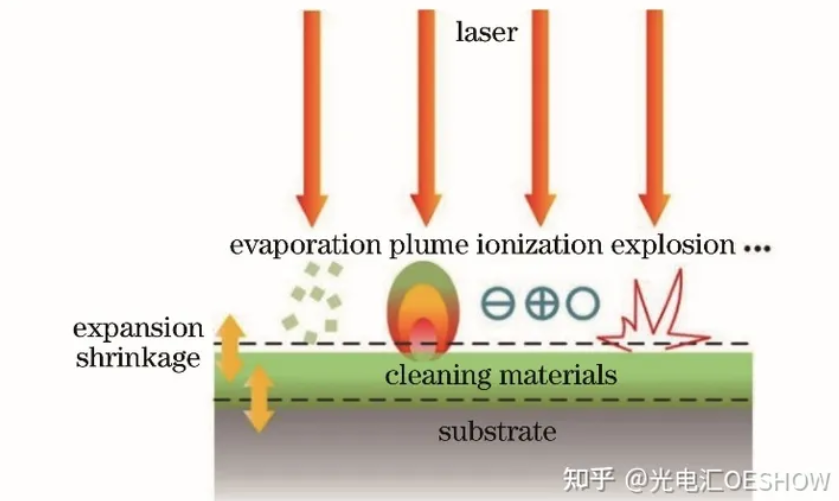
Figure 1 Process schematic of laser ablation cleaning method
When the laser irradiates the surface of the material, both the substrate and the cleaned material first undergo thermal expansion. As the laser and cleaning material interaction time increases, if the temperature is lower than the cleaning material of the gasification threshold, the cleaning material only physical change process, cleaning material and the substrate thermal expansion coefficient of the difference between the interface at the interface resulting in pressure, the cleaning material buckling, torn from the surface of the substrate, cracks, mechanical fracture, vibration breakage and other phenomena, the cleaning material in the form of a jet to be removed or stripped from the surface of the substrate.
If the temperature is higher than the gasification threshold temperature of the cleaning material, two situations will occur: 1) the ablation threshold of the cleaning material is less than the substrate; 2) the ablation threshold of the cleaning material is greater than the substrate.
Both cases of cleaning materials are melting, gasification and ablation and other physicochemical changes, cleaning mechanism is more complex, in addition to the thermal effect, but also may include cleaning materials and substrates between the molecular bond breakage, cleaning materials decomposition or degradation, phase explosion, cleaning materials gasification occurs at the moment of ionization, the generation of plasma and so on.
(2) liquid film-assisted laser cleaning
Method mechanism mainly has a liquid film boiling gasification and vibration. The use of the need to choose the appropriate laser wavelength, to some extent can make up for the lack of impact pressure in the laser ablation cleaning process, can be used to remove some of the more difficult to remove the cleaning object.
As shown in Figure 2, a liquid film (water, ethanol or other liquids) is pre-covered on the surface of the cleaned object, which is then irradiated with a laser. Liquid film absorbs laser energy resulting in liquid media explosion, explosion of boiling liquid high-speed movement, the energy transferred to the surface layer of the cleaning material, high transient explosive force is sufficient to remove the surface dirt to achieve the purpose of cleaning.
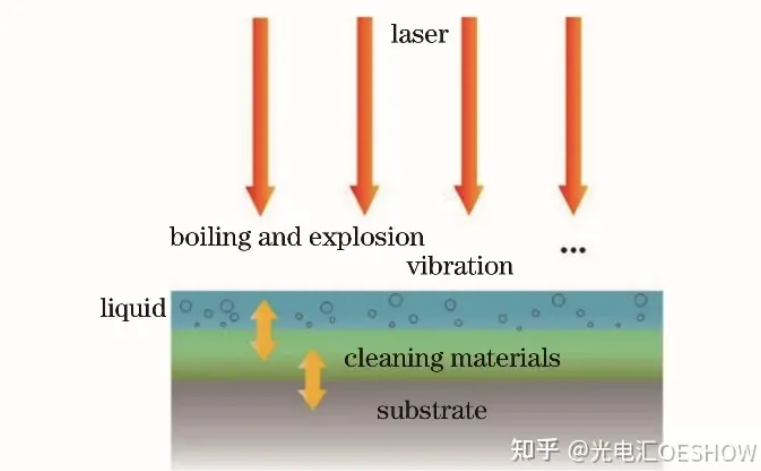
Figure 2 Schematic diagram of the liquid film-assisted laser cleaning process
There are two disadvantages of the liquid film-assisted laser cleaning method:
The process is troublesome and difficult to control;
Due to the use of liquid film, the chemical composition of the surface of the substrate after cleaning is easy to change, generating new substances.
(3) Laser shock wave cleaning method
Process mode and mechanism and the first two are very different, the mechanism is mainly shock wave force removal, cleaning objects are mainly particles, mainly for the removal of particles (submicron or nanometer level). Process requirements are very strict, both to ensure that the air can be ionized, but also to make the laser and the substrate to maintain a suitable distance between to ensure that the role of the impact on the particles is large enough.
The process schematic for laser shock wave cleaning is shown in Figure 3, where the laser is directed parallel to the surface of the substrate, with no contact with the substrate. Move the workpiece or laser head will be adjusted to the laser focus near the particles, laser output, the focus of the air will occur ionization phenomenon, resulting in shock waves, shock waves to the ball-shaped rapid expansion expansion, and extended to the particles in contact. When the moment of the transverse component of the shock wave acting on the particles is greater than the moment of the longitudinal component and the adhesion force of the particles, the particles will be removed by rolling.
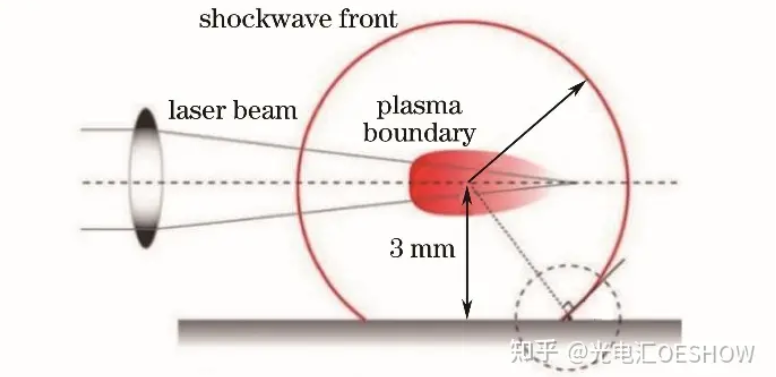
Figure 3 Schematic diagram of the laser shockwave cleaning process
Laser cleaning technology
In the 1980s, the rapid development of the semiconductor industry on the surface of the silicon wafer mask pollution particles of the cleaning technology put forward higher requirements, the key point is to overcome the pollution of micro-particles and the substrate between the great adsorption, the traditional chemical cleaning, mechanical cleaning, ultrasonic cleaning methods can not meet the needs of the laser cleaning can be a solution to this kind of pollution, the relevant research and application has been rapidly developed.
In 1987, the first patent application on laser cleaning. Into the 1990s, Zapka and other successful application of laser cleaning technology in the semiconductor manufacturing process, in addition to the mask surface of the micro-particles, the realization of the early laser cleaning technology in the industrial field of application. 1995, the researchers used a 2 kW TEA-CO2 laser successfully realized the aircraft fuselage paint removal cleaning.
Into the 21st century, with the high-speed development of ultrashort pulse laser, domestic and foreign research and application of laser cleaning technology has gradually increased, focusing on the surface of metal materials, foreign typical application of aircraft fuselage paint removal, mold surface in addition to oil, the engine in addition to the internal carbon deposits and pre-weld joints such as surface cleaning. U.S. Edison Welding Institute laser cleaning of the FG16 fighter, when the laser power of 1 kW, the cleaning volume per minute is 2.36 cm3.
It is worth mentioning that the research and application of laser paint removal for advanced composite parts is also a hot spot. Composite surfaces such as propeller blades of U.S. Navy HG53 and HG56 helicopters and flat tails of F16 fighter jets have realized laser paint removal application, while the application of composite materials in aircraft in China is relatively late, so such research is basically in the blank.
In addition, the use of laser cleaning technology on CFRP composite joints before gluing surface treatment to improve the strength of the joints is also one of the current research focuses.Adapt Laser company to the Audi TT automobile production line to provide a fiber laser cleaning equipment, in order to clean the surface of the lightweight aluminum alloy door frame oxidation film. The British RollsGRoyce company used the laser to clean the oxidized film on the surface of titanium alloy aero-engine parts.
Domestic scholars in the field of laser cleaning research time is late, coupled with the short pulse laser itself is expensive, need higher cleaning efficiency to achieve high value in practical applications, so the current relevant applications are very few.
In recent years, some domestic universities, research institutes and enterprises have carried out research on the application of laser cleaning technology in the industrial field, and the manufacture of laser cleaning equipment.
Harbin Institute of Technology carried out automotive hot-forming steel surface Al-Si coating removal, steel surface rust, aerospace aluminum alloys and titanium alloys in addition to the oxide film before welding, aluminum composite material surface in addition to dirt, ceramic materials, such as cleaning research.
China Academy of Engineering Physics carried out research on tire molds in addition to release agents, aircraft wings and radomes (composite materials) and tank armor paint removal, rust removal of marine components.
Shanghai Linshi Laser Science and Technology Co., Ltd. carried out a turbine blade, aerospace air intakes (titanium alloy) and light alloy surface cleaning process research before welding, and has developed a laser cleaning equipment.
Shenyang Institute of Automation, Chinese Academy of Sciences to carry out nuclear power pipeline internal dirt cleaning process exploration.
Ltd. to carry out the removal of planetary wheel frame (cast aluminum) and from the bevel gear surface oxides, copper parts of the surface of the oxide, the piston surface of graphite and saw blade surface paint process exploration.
Soochow University has carried out research on removing rust from automobile worm shells, removing dirt from track maintenance and removing scale from insulated porcelain vases.
Conclusion
In terms of theory and process, although a large number of experiments have been carried out both at home and abroad in the process research of laser cleaning, the theoretical and mechanistic research of laser cleaning is not yet perfect. Although relevant physical models have been established, these models still have great limitations. In terms of practical application, the gap between domestic and foreign countries is large, this is because the domestic laser cleaning process is not mature enough, the equipment limits the laser cleaning efficiency and precision, especially our country can not independently research and development of high-power short-pulse lasers, which is a major bottleneck limiting the development of high-efficiency laser cleaning complete sets of equipment. Laser cleaning technology as a laser manufacturing in an advanced technology, in the industrial development of the application potential is huge, vigorously develop laser cleaning technology has a very important strategic significance.
This article is rewritten from the “Advances in Lasers and Optoelectronics” - “laser cleaning technology in the industrial field”.